> For the complete documentation index, see [llms.txt](https://docs.bitbond.com/asset-tokenization-suite/llms.txt). Markdown versions of documentation pages are available by appending `.md` to page URLs; this page is available as [Markdown](https://docs.bitbond.com/asset-tokenization-suite/token-tool/airdrop-tokens/airdrop-nfts.md).
# Airdrop NFTs
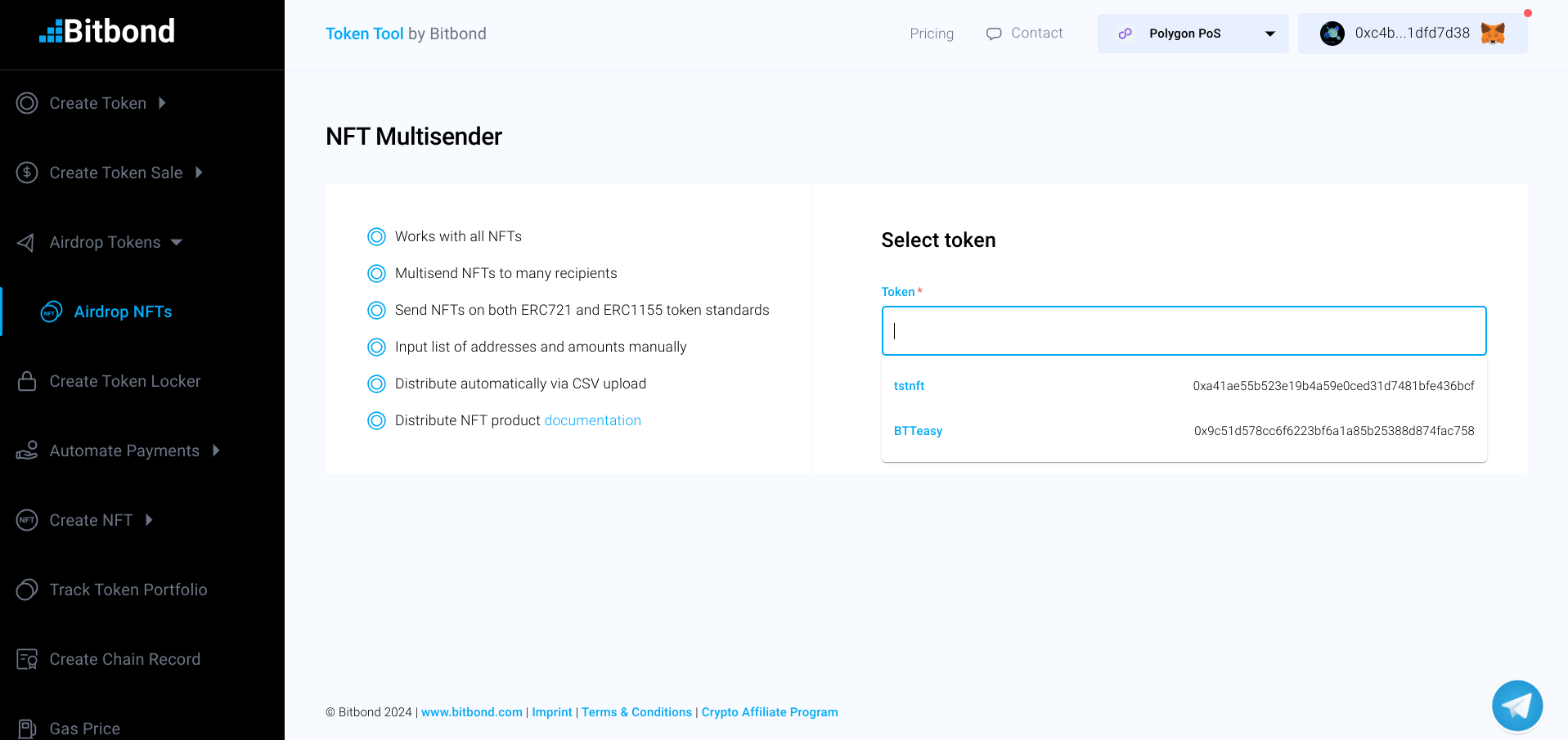
This function allows you to send NFTs to many recipients (also called [*multisend NFT*](https://tokentool.bitbond.com/distributenft/ethereum)) in one transaction. The NFTs that you want to send have to be in the wallet that is connected to Token Tool.
After selecting the NFT from the drop-down (or pasting in the contract address of the NFT) paste a list of recipient addresses and the respective token IDs (plus the respective amount in the case of ERC1155 tokens) in the Select token field.
The list should include each recipient address and the respective token ID separated by a comma. Make sure there are **no spaces**. Each address has to be on a newline like in this example:
{% code lineNumbers="true" %}
```
0x53c23c9d7fa6468f3c99c45791998e259baa32cd,0
0xc26f229db52da0ebf814dfd58a8949cdf6b6baee,1
0xdc47799ecb3433e5805dfe034f5fc6eb72f68d1e,2
0xa1cba1a1fba99c53c91b66863bc76ce00e7da787,3
0x4491bb52e325f16dd825192517b7e5daf3bc7391,4
```
{% endcode %}
After you click Continue you will be asked to approve Token Tool to send NFTs on your behalf. You can control this approval by determining the maximum amount of NFTs that Token Tool can send. Your tokens will be sent to batches of 150 addresses. If there are more than 150 addresses in your list, you will have to approve each batch separately.
After sending the NFTs is completed, you can also revoke the permission for sending from Token Tool via Metamask.
When sending NFTs, different error messages can appear:
* Error 1: Invalid wallet address
* Error 2: Duplicated address with Line X
* Error 3: Incorrect punctuation mark. Use commas between addresses, TokenID and amount and no spaces in-between
Some quick actions can be selected to resolve duplicate addresses:
* Keep duplicated addresses
* Delete duplicated records
Other errors have to be fixed manually or can be deleted automatically by using the “Delete incorrect records” function.
---
# Agent Instructions
This documentation is published with GitBook. GitBook is the documentation platform designed so that both humans and AI agents can read, navigate, and reason over technical content effectively. Learn more at gitbook.com.
## Querying This Documentation
If you need additional information that is not directly available in this page, you can query the documentation dynamically by asking a question.
Perform an HTTP GET request on the following URL with the `ask` and `goal` query parameters:
```
GET https://docs.bitbond.com/asset-tokenization-suite/token-tool/airdrop-tokens/airdrop-nfts.md?ask=&goal=
```
`ask` is the immediate question: it should be specific, self-contained, and written in natural language.
`goal` is what the user is ultimately trying to achieve, the reason they need the answer. Sharing it helps GitBook give you a better, more relevant answer. A goal is most helpful when it describes the outcome the user wants rather than restating the question. For example, with `ask=how do I create an API token`, a goal like `build a script that syncs our docs to a CMS` lets GitBook tailor the answer to that use case.
The response will contain a direct answer to the question and relevant excerpts and sources from the documentation.
Use this mechanism when the answer is not explicitly present in the current page, you need clarification or additional context, or you want to retrieve related documentation sections.